
BHARAT · Part 04 · Topic guide
Agriculture in India and Viksit Bharat
BHARAT Part 04 follows farming beyond the harvest towards value chains and enterprise. This guide explains the terms, what the cited sources establish, and why older figures must not be read as today’s facts.
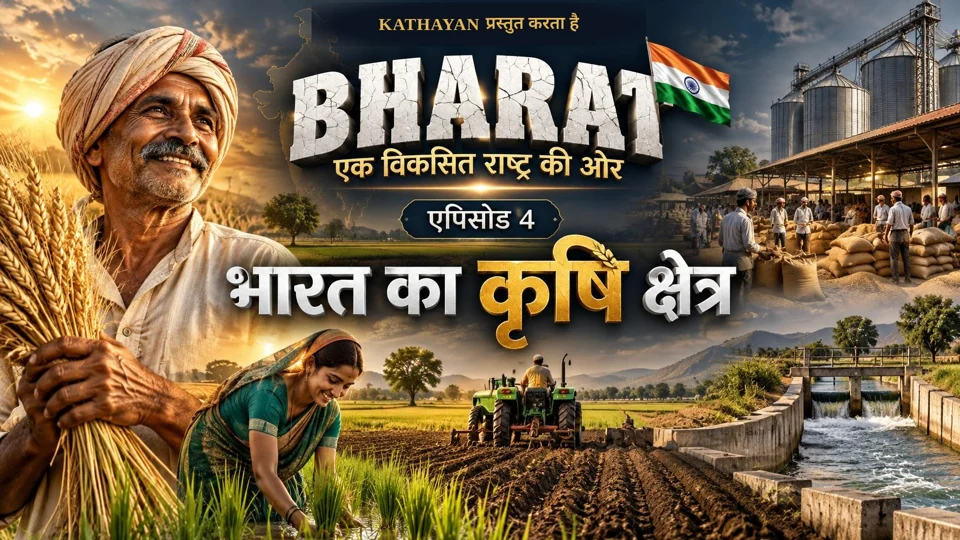
Free to watch · Hindi
India's Agriculture Sector
The land and the livelihood — how cultivation, water, markets, storage and the farming household together shape one of the longest-standing and most widely shared livelihoods in India.
Key terms
- Operational holding
- Land operated as a technical unit, as recorded by the Agriculture Census. It is not necessarily the same as legal ownership.
- Source: Government of India; hosted by FAO
- Rain-fed farming
- Farming that depends primarily on rainfall, with little or no irrigation, as described in an FAO India project.
- Source: FAO India
- Farmer Producer Organisation (FPO)
- A collective organisation through which dispersed smallholders can take part in markets and services, as explained in NABARD’s FPO primer.
- Source: NABARD
What the sources establish
The Agriculture Census 2015–16 report records the number and area of operational holdings, providing a historical baseline for discussing farm scale.
NABARD’s March 2015 primer describes the constraints of dispersed smallholders and the role of collective organisation in market participation.
Source: NABARD
An FAO India project that ran from June 2019 to December 2021 distinguishes rain-fed farming and discusses natural-resource pressures.
Source: FAO India
What they do not tell us
- The 2015–16 census describes its own reference period, not the situation in 2026.
- The NABARD primer is not a current count of FPOs and does not guarantee higher prices or incomes for members.
- The FAO project context should not be turned into a nationwide measurement.
- No source here shows that one technology — drones, platforms or irrigation equipment — solves every constraint.
Questions BHARAT Part 04 asks
- How does a harvest reach a buyer in usable condition and on workable terms?
- Where can shared services help small holdings, and where do local conditions need something else?
- Does proposed infrastructure fit the actual crop, volume, location and buyer?
Kathayan’s interpretation — questions for evaluation, not results established by the sources.
Sources & scope
Older documents describe their own reference periods, not current estimates. BHARAT is an independent Kathayan documentary series, not a government publication; official documents are cited as sources, not sponsors.
This guide offers context, not advice on crop selection, investment or borrowing.
- Agriculture Census 2015–16: Number and Area of Operational Holdings (2019 report) ↗
Government of India; hosted by FAO · Historical baseline; operational holdings are not necessarily ownership units.
- Farmer Producer Organisations — Frequently Asked Questions (March 2015) ↗
NABARD · Institutional primer, not current counts or a guarantee of incomes.
- Sustainable and resilient livelihood options for rain-fed areas of India (2019–2021 project) ↗
FAO India · Project context for rainfall dependence and resource pressures; no nationwide extrapolation.