
BHARAT · Part 03 · Topic guide
Health care in India and Viksit Bharat
BHARAT Part 03 places health within India’s development story. This guide explains the terms used in health-policy discussions, what official documents state, and how carefully their numbers must be read.
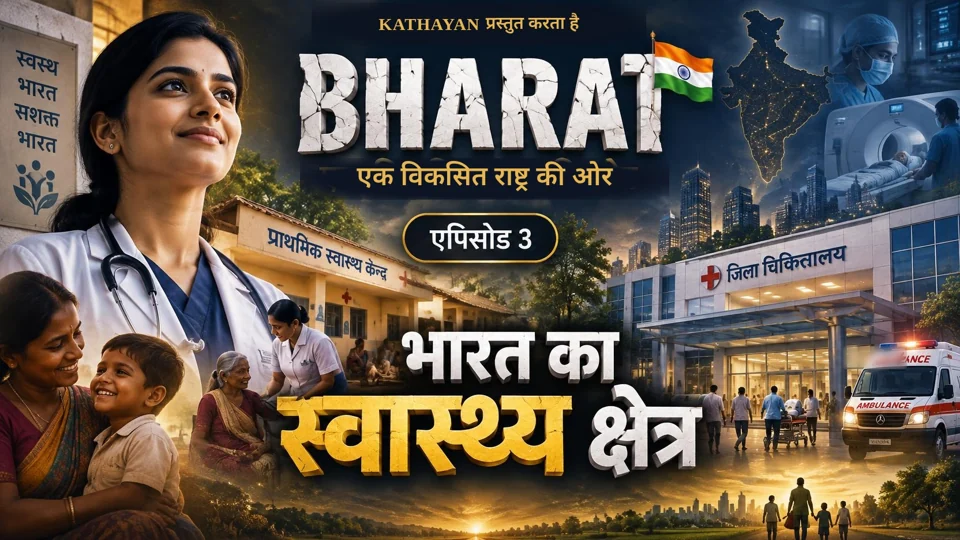
Free to watch · Hindi
India's Health Sector
Care close to home — how primary health centres, district hospitals, insurance cover and the people who staff them decide what health actually reaches a family.
Key terms
- Comprehensive primary health care
- The expanded model of care in the Health Ministry’s 2018 guidelines, covering facilities, workforce, medicines, diagnostics and monitoring, with preventive and promotive functions.
- Source: Ministry of Health and Family Welfare
- Out-of-pocket expenditure (OOPE)
- Health spending paid directly by households, reported in National Health Accounts as a share of total health expenditure — a system-level measure, not the share of any one family’s bill.
- Source: Ministry of Health and Family Welfare
- Sanctioned and filled posts
- A sanctioned position is not necessarily a filled one. Staffing reports record different cadres and facility levels, which are not interchangeable.
- Source: National Health Systems Resource Centre
What the sources establish
The Ministry of Health and Family Welfare’s 2018 guidelines set out the intended design of comprehensive primary care, including requirements for workforce, medicines and diagnostics.
A Ministry release dated 13 December 2024 reports National Health Accounts estimates for 2021–22: out-of-pocket expenditure was 39.4% of total health expenditure.
The National Health Systems Resource Centre’s state-wise 2023 report documents staffing by cadre and facility level in the district public health system.
What they do not tell us
- The 2018 guidelines describe intended service design; they do not show that every location delivers the full package today.
- The 39.4% figure is for financial year 2021–22 and is a share of total health expenditure — not a household bill share and not a 2026 estimate.
- Unlike staffing measures should not be combined into a single national shortage number.
- Calling a service digital does not show that it improves continuity of care; that needs evidence for the specific tool and setting.
Questions BHARAT Part 03 asks
- Can a patient find the right professional, tests and medicines — and come back for follow-up?
- Is care affordable across the whole journey, including travel and repeat visits?
- Does the system connect prevention, screening, referral and treatment reliably?
Kathayan’s interpretation — questions for evaluation, not results established by the sources.
Sources & scope
Older documents describe their own reference periods, not current estimates. BHARAT is an independent Kathayan documentary series, not a government publication; official documents are cited as sources, not sponsors.
This guide explains the health system; it is not personal medical advice.
- Comprehensive Primary Health Care through Health and Wellness Centres — Operational Guidelines (2018) ↗
Ministry of Health and Family Welfare · Service design and intended requirements; not proof of uniform implementation.
- National Health Accounts 2021–22 figures — ministry release (13 December 2024) ↗
Ministry of Health and Family Welfare · OOPE is a share of total health expenditure for FY 2021–22, not a household bill share.
- Human Resources for Health in District Public Health System — State-wise Report 2023 ↗
National Health Systems Resource Centre · State, cadre and facility-specific staffing evidence.